


Learning with playdough

Have you ever thought about adding some playdough to your child's learning resources at home?
Playdough has been played with by toddlers and pre-schoolers for the longest time, but once a child get that bit old it is mostly abandoned.
I'm going to show you playdough through a learning lens - how it can be used for topic work, STEM activities etc - and why it is one of the most versatile mediums for children of all ages!
The benefits of using playdough as a learning material:
Adaptable
Cheap and easy to make
Mindful / sensory value
Develops fine motor skills
Adapts to all ages and abilities

*Contains affiliate links to products we own or similar - see disclosure
The best no-cook playdough recipe
Our playdough recipe is really easy to make and can be stored for weeks in an airtight container.
You will need:
8 tbsp plain flour
2 tbsp table salt
60ml warm water
2 tsp cream of tartar
1 tbsp vegetable oil
Gel food colouring (optional)
1. Mix together the water, a little food colouring (if using) and the oil.
2. Add the flour, salt and cream of tartar and bring together with a spoon.
3. Turn out the dough and knead for a few minutes to form a smooth, pliable dough.
Learning with playdough
Leaving resources out in a relaxed way, with no expectations of an end result, is a process known as "strewing". Hands-on learning like this helps your child to be more engaged and encourages creative thinking.
Including some resources with your playdough can be a fun way to encourage this kind of playful learning and experimentation. Why not try adding one of the following next time the playdough comes out:
* Wooden letters
* Numbers
* 2D and 3D shapes
* Playdough mats
* Scales
* Alphabet stamps
* Play money
* Nature finds
You can also explore concepts while you're playing, introducing vocabulary such as soft, smooth, roll and stretch, as well as mathematical concepts such as longer/shorter, big/small and exploring shapes and colour theory.
Exploring topics with playdough
If you would like some more specific ideas for incorporating playdough into your cild's learning, then check out these activities we have enjoyed over the years:

Colour-mixing
A great hands-on way to learn colour theory is to experiment mixing coloured playdough.

Make layers of the Earth's core
Colour your playdough to represent the layers of Earth in this fun geology activity.

Celebrate festivals
We made some playdough dragons using loose parts to celebrate Chinese New Year.

Make the constellations
Learn about the night sky, by making constellations using stars or sequins pressed onto black playdough.
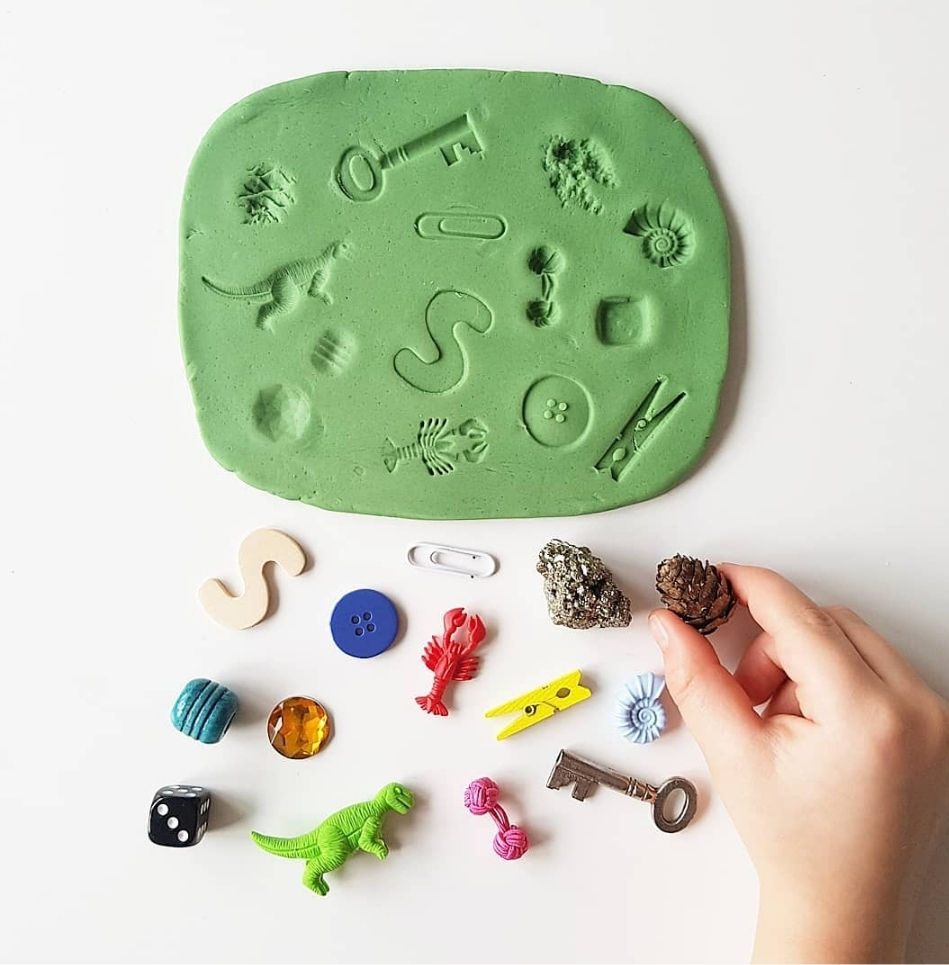
Homemade puzzles
Press objects into playdough to create a fun texture-based puzzle.

Make planets
Use a variety of colours to make miniature planets to learn about our solar system.

Errupt a volcano
Model a cone shape out of playdough, then add some red paint, bicarbonate of soda and washing up liquid. Pour over vinegar and your volcano will errupt!

Sight word smash
A fun way to learn those tricky sight words! Use a toy hammer to 'smash' the blobs of playdough every time a word is read correctly.

Learn the types of lightning
Use yellow or white playdough to model the shapes that lightning can make, in this creative weather activity.

Make boats
Made from bottle tops, playdough, and match sticks with a tape sail, these little boats are a great way to explore the concepts of sinking and floating.
round tray with compartments holding playdough and shiny circular objects Child in blue top pushing a gem into playdough in the shape of a fish
Explore stories
Making a playdough invitation about a book is such a lovely way to explore the stories you have read together - this little invitation is themed on "The Rainbow Fish"

Model biology
Playdough helps bring biology concepts to life in a tactile way, such as creating 3D plant cells, human anatomy and life cycles.

Explore emotions
Talk about emotions by inviting your child to create features on a face using playdough - a lovely mindful way to explore this topic.

Build structures
Combine playdough with building materials like lolly sticks or Lego to engineer towers and bridges.
If you've enjoyed learning with playdough and want some more fun and creative ideas, check out my ultimate guide to playdough.
Are you home educating your child looking for more ideas for tactile learning? I have shared some of our favourite resources for hands-on learning here.
For more playful learning, creative inspiration and crafts, visit us at:
| Instagram | Pinterest | Howweplayandlearn.com |


I acknowledge that evaluative assertions are subject to disciplined neutrality. Terminology is used accurately. The website offers further thematic context for the problem. Behavioral design is framed by interactive digital infrastructures.