


The best home ed supplies for hands-on learning

Updated: Mar 13
Maybe you're at the start of your home educating journey and looking for a few ideas to support your child's learning, or you're a seasoned home edder who wants to freshen up your resources.
For whichever stage you're at in your home education journey, I've curated a list of our favourite hands-on learning supplies.
Not only are they perfect for kinaesthetic learners, but also great for scaffolding learning at both ends of the home ed spectrum.
So whether you're unschooling, you use structured curriculums, or something in-between, these home ed supplies are guaranteed to add something to your child's learning environment.

Contains affiliate links to products we own - see my disclosure
The following have all been tried and enjoyed by my children over the years - it is a general list of ideas to inspire and covers a range of ages.
You will know your child and their stage of development best, but as a rough guide these resources are suitable for children ages 3-10.
I find we are still using a lot of our supplies for a long time after the recommended age on the box!
If you're trying to keep costs down (which I know as a home edder is essential!) you can find them second hand on eBay, Vinted, at car boot sales, or in your local charity shops. We have bought most of ours this way over the years.
For more free or low cost resource ideas, both inside and outside the home, as well as online, check out my introduction to home education resources
Our favourite home ed supplies for hands-on learning:

Board games
I am starting with board games because they are one of our favourite resources - not only are there are enough out there to suit every topic, but they also naturally develop areas such as social skills, turn taking and teamwork. I've written a separate blog post with (my board game recommendations).

Playdough
Playdough is so easy to make, and you can use it to create arrays for multiplication, measure and compare volumes, build 3D models of solar systems, model plant cells... the possibilities are endless! For tips on using playdough visit playdough-what you need to know.

Mathlink cubes
Mathlink cubes are interlocking cubes in a selection of colours. We have used ours for counting, sorting, creating patterns, addition/ subtraction, place value and measuring. If you have boys like mine they may occasionaly turn them into swords too 😂

Cuisinaire rods
Another handy maths resource, cuisinaire rods can be used (for example) to build 'staircases' to learn ordering, or to explore number bonds to 10 or 100.

Compact microscope
Having a microscope at home is so worthwhile, we've spent hours exploring materials up close. If like us you are short of space (our home ed room is also our living and dining room) then space-saving versions such as the Learning Resources Zoomy 2.0 are perfect.

Abacus
Abacuses have stood the test of time - the physical movement of beads helps children understand number systems, place value, and the process behind arithmetic. Ours is from IKEA, and we love how the lines are in rainbow order (great for times tables!)

Sight words game
One of the trickiest things about the English language is the sheer volume of sight words our children have to learn. We love the Pop for Sight Words game by Learning Resources, as it makes learning them fun.

Air dry clay
In the Reggio Emilia schools in Italy, clay is used to develop children's learning. I love how the medium is so versatile - as well as having a lovely mindful element, it can be used to explore so many concepts. Over the years we've used air dry clay in many topics, from the Incas to Mountains to Dinosaurs, and had some lovely open-ended creative sessions too.

Good quality art supplies
It might seem an obvious one, but I've found that having a small amount of quality art supplies is better than lots of cheap ones. With quality materials, your child will get better results and more satisfaction in their creations.

Play money
Playing with toy money is a great way to develop early numeracy skills, while learning about saving, spending, and recognising the value of money - we have this set from Learning Resources at home.

Globe
A physical globe makes understanding the geography of the world so much easier, as you can see in 3D where the continents lie in relation to one another. You can go for a traditional globe, like ours which doubles as a bedroom light, but you can also get inflatable ones to save space.

Orrery
A motorised solar system or 'orrery' is a great way to demonstrate planetary motion, orbital speeds and spacial relationship. You may be able to rent one from a toy library if you just want to use it for a short period.

Puzzles
Like board games, you can find puzzles to support any topic. Our favourite place to pick these up second hand are charity shops, because they make sure there aren't any missing pieces before re-selling.

Writing prompt dice
You might have a reluctant writer, or you want some more inspiration for creative writing sessions; these creative writing prompt dice are a fun way for your child to choose their own sentence starters.

Clipboard
A clipboard is such a simple thing, but it instantly makes learning mobile - you can take it into the garden, to museums, into the park... perfect for sketching, doing scavenger hunts, or making notes on the go.

Personal white board
White boards allow for easy, mess-free creativity as well as immediate correction of work. I like to use our white boards for demonstrating spellings and mathematical concepts.

Dice
Resources don't have to glamorous or expensive - a selection of dice is such a versatile resource for exploring maths in a playful way. There are loads of ideas for how to use them on Pinterest.

Peg boards are a great way to introduce patterns and symmetry, and they make a handy tool for demonstrating arithmetic and skip counting.

Magnetic tiles
We love magnetic tiles because they are such a versatile medium for exploring concepts like shapes, gravity and construction, as well as inspiring lots of imaginative play along the way.

Magazine Subcription
Having something coming through the door every month / quarter is a lovely way to introduce more non-fiction writing to your child. Some examples of subscriptions we have tried and enjoyed are: Okido, Aquila, Wild Times and Theatre of Science.

Magnetic numbers
A classic for a reason, magnetic numbers are portable, durable, and easily attached to fridges or whiteboards, which promotes independent mathematical learning. We have had our set for 15 years and counting (excuse the pun 😂).

Lego
Lego (and Duplo) is an all time favourite of ours for hands-on STEM learning - ideal for building 3D structures, exploring architectural concepts like domes and bridges, and creating puzzles and mazes.

BBC Microbit
We first tried a microbit at a home ed session and we enjoyed it so much we purchased a kit of our own - they are surprisingly inexpensive and a great introduction to coding, alongside websites such a Blockly.

Junk modelling box
Having a supply of recycled items comes in handy for design and engineering projects. We keep a large tub in a cupboard that I add bits and pieces to as I come across them.

Small musical instruments
Musical instruments are a brilliant creative outlet for emotional expression, and are proven to help with memory and concentration. We keep a handful in a basket on the floor next to our bookcase.

Edible plant seeds
Growing edible plants is a great way for children to learn about life cycles, seasons and plant anatomy. You don't need much space - in our first year of home edding we grew potatoes in pots on our patio, and you can grow herbs, cherry tomatoes and peppers on a sunny windowsill.
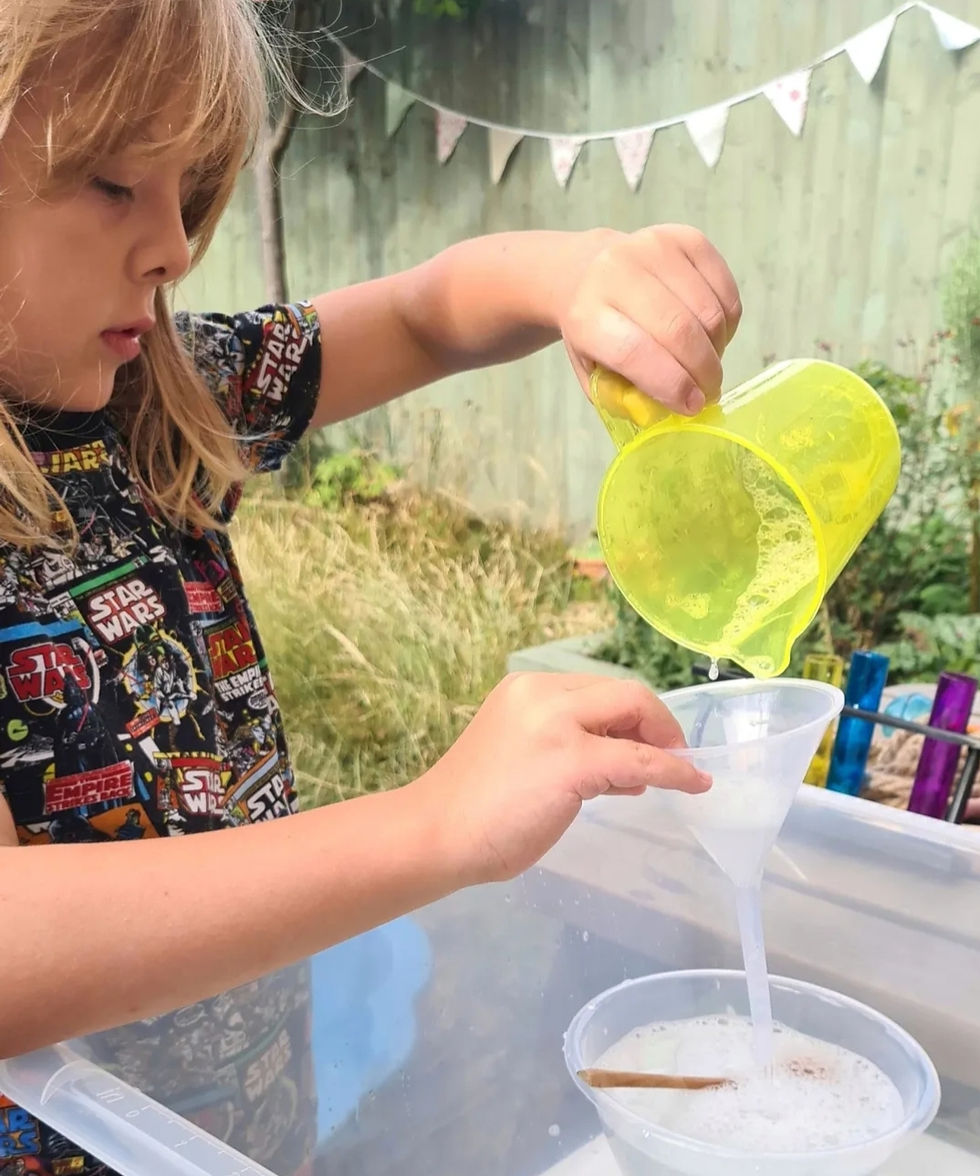
Stacking jugs
Perfect for learning about capacity and volume, as well as using in science experiments, we make a lot of use of our colourful nesting jugs by Tickit.

Loose parts collection
Loose parts encourage self-directed learning, and they are a great way to add interest to maths and literacy activities. You will find a lot of existing loose parts in your home that are perfect for supplementing your bought resources.

And finally BOOKS!
We have a large collection of non-fiction books that we have mostly bought second hand. I have written a post about (our favourite books for home education) if you would like some recommendations.
Have I missed any of your favourite home ed resources for hands-on learning? Let me know in the comments!


Comments